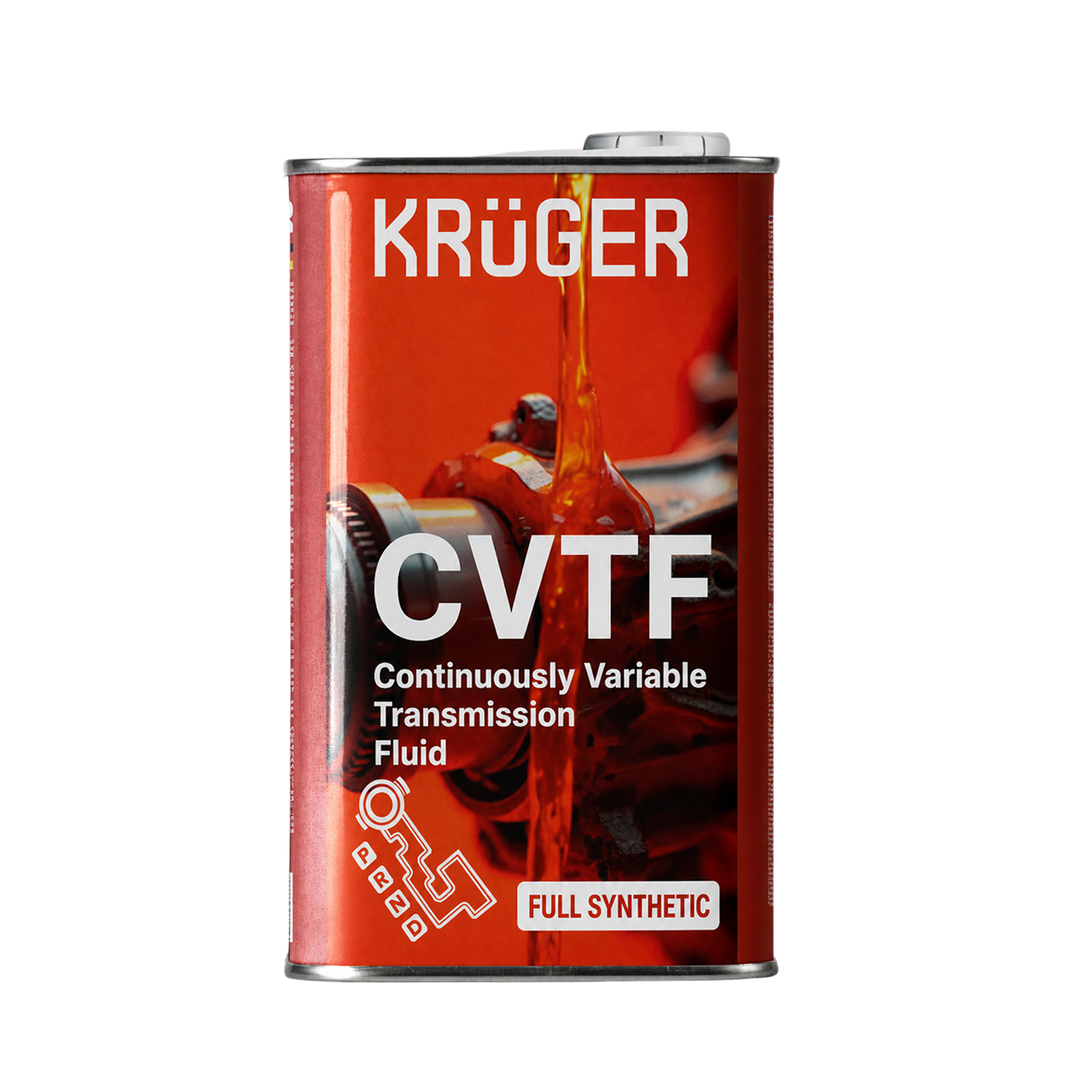
CVT / Continuously Variable Transmission Fluids
Krüger CVT Multi Vehicle
Fully synthetic continuously variable transmission fluid (CVT) based on the PXL 7811 additive package — smooth variator operation, wear protection and reduced fuel consumption.
Available pack sizes
Krüger CVT Multi Vehicle is a fully synthetic fluid for continuously variable transmissions (CVT), developed on the basis of the modern PXL 7811 additive package. It is designed for the CVT transmissions of European, Asian and American passenger and commercial vehicles. It ensures smooth variator operation, high protection against wear, corrosion, rust and oxidation, and helps reduce fuel consumption thanks to its low viscosity. Intended for modern continuously variable transmissions (CVT) where the manufacturer specifies the use of a CVT Fluid class fluid. Suitable for passenger cars, SUVs, light commercial vehicles and other equipment of European, Asian and American manufacture. Storage Store the product in original tightly sealed containers in a dry, clean and well-ventilated area, protected from direct sunlight, moisture and heat sources. Recommended storage temperature: +5 °C to +40 °C. Shelf life: up to 60 months under the recommended storage conditions. Safety Avoid prolonged or repeated contact with skin. Use appropriate personal protective equipment when handling. Read the Safety Data Sheet (SDS) before use. Disclaimer The information provided in this technical data sheet is based on the data and laboratory tests available at the date of publication. The values stated are typical product characteristics and should not be regarded as official specifications. The user is responsible for determining the product's suitability for specific applications. Krüger Oil reserves the right to change the formulation or technical characteristics of its products without prior notice.
Key benefits
- Smooth variator transmission operation
- Fuel savings thanks to low viscosity
- Excellent wear protection
- High oxidation resistance
- Reliable corrosion protection
- Excellent rust protection
Compatible vehicles
Beyond the requirements listed above, Krüger CVT Multi Vehicle may also be used in continuously variable transmissions (CVT) of other vehicle manufacturers where the equipment manufacturer prescribes the use of a CVT Fluid with performance characteristics equivalent to the specifications listed above and given in the vehicle's owner's manual.
| Parameter | Value | Test method |
|---|---|---|
| Fluid type | CVT Fluid | — |
| Base oil | Fully synthetic | — |
| Wear protection | Excellent | — |
| Corrosion protection | Excellent | — |
| Thermal-oxidative stability | Excellent | — |
| Variator operation smoothness | Excellent | — |
OEM approvals
- Industry Profile PXL 7811
- Audi Multitronic transmission
- BMW & Mini Cooper EZL 799 Fluid / 83 22 0 136 376 / 83 22 0 429 154
- Mini Cooper EZL799 Fluid / EZL799A Fluid / ZF CVT V1 Fluid
- Chery CVT Transmission
- Daihatsu AMMIX CVT Fluid DFE
- Daihatsu AMMIX CVT Fluid DC
- Daihatsu AMMIX CVT Fluid DFC
- Daihatsu Fluid TC
- Dodge / Jeep / Chrysler NS-2 Fluid
- Dodge / Chrysler / Jeep Mopar CVT+4
- Fiat Tutela Car CVT N.G
- Ford WSS-M2C928-A / Hybrid e-CVT
- Fujijyuuko i-CVTF FG
- GM / Saturn DEX-CVT Specification
- Honda Multimatic HMMF Fluid
- Honda HCF-2 / HEVF
- Honda Z-1 CVT
- Honda CVT Transmission
- Hyundai / Kia CVT-1 Fluid
- Hyundai / Kia SP III (CVT)
- Jatco CVT 8 Hybrid
- Idemitsu CVTF-EX1
- Lexus Fluid TC
- Lexus Fluid FE
- Mazda JWS 3320T
- MB 236.20
- MG Rover EM-CVT
- Mitsubishi CVTF-J1
- Mitsubishi CVTF-J4 / J4+
- Mitsubishi SP-III (CVT)
- Mitsubishi CVTF ECO J4
- Nissan NS-1
- Nissan NS-2
- Nissan NS-3
- Nissan N-CVT
- Punch CVT
- Renault Elf Matic CVT
- Subaru iCVT
- Subaru iCVT FG
- Subaru ECVT
- Subaru Lineartronic CVT II Fluid
- Subaru Lineartronic High Torque CVT Fluid
- Subaru NS-2
- Suzuki CVTF TC
- Suzuki CVTF 3320
- Suzuki CVTF 4401
- Suzuki NS-2
- Suzuki CVT Green 1
- Suzuki CVT Green 2
- Suzuki CVT Green 1V
- Toyota CVTF TC
- Volvo CVT 4959
- VW / Audi G 052 516
- VW / Audi G 052 180
- Zotye CVTs
Recommended for
- Continuously variable transmissions (CVT) requiring a CVT Fluid class fluid
- Passenger cars and SUVs
- Light commercial vehicles
- Equipment of European, Asian and American manufacture
-
Smooth variator transmission operation
-
Fuel savings thanks to low viscosity
-
Excellent wear protection
-
High oxidation resistance
-
Reliable corrosion protection
-
Excellent rust protection
-
High thermal stability
-
Extends variator transmission service life